
|
"What if just your beard starts to turn?" This article requires testing. You can help Left 4 Dead Wiki by experimenting with gameplay, and then changing it. |

|
"It slimed me! God damn it! I'm covered in goo!" This article/section requires a clean up, you can help by removing unnecessary information, fixing up grammar/punctuation, and following the Manual of Style. If necessary take a look on the talk page to know what needs to be cleaned up. |
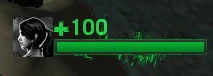
Zoey's health bar at 100 health.
Health (also called Hit Points or HP) is the hit point total that governs the survivability of the Survivors and Infected in Left 4 Dead and Left 4 Dead 2. All Survivors begin with a total of 100 health at the start of every campaign. Health points remaining at the end of one Chapter are carried over to the start of the next chapter. In Versus, the Survivors will always begin a chapter at full health.
Health points are lost as Survivors take damage from falling from a high enough distance, attacked by infected, friendly fire (with the exception of Easy difficulty), or standing in fire. In the case of health obtained by Pain Pills or Adrenaline, it will slowly trickle down. This is the same case for Survivors revived from incapacitation.
When a Survivor's total health is 39 or less, the character begins limping and their walking movement speed decreases from 220 Hammer Units (4.19 m/s or 13.75 ft/s) to 150 Hammer Units (2.86 m/s or 9.38 ft/s) per second. An incapacitated player who has been revived but not healed by a First Aid Kit will decrease to zero in the space of 37 seconds after reaching 1 point of health and suffer a further walking movement speed degradation to 85 Hammer Units (1.62 m/s or 5.31 ft/s) per second.
Crouching movement speed is unaffected by any of the above health damage constraints, always at a fixed 75 hammer units (1.43 m/s or 4.69 ft/s) per second.
A survivor's speed will always rise to 260 hammer units per second while under the effects of adrenaline, regardless of their health before taking the shot.
However, the mechanics are slightly different when the Survivors are introduced to water, this can commonly be seen in the Hard Rain campaign. When a Survivor is in water that is up to their knees their speed changes from 220 Hammer Units to 115 Hammer Units per second, this is similar when a character's health is 39 or less, changing their speed of 150 Hammer units to 115 Hammer Units per second. At 1 health point with a movement speed of 85 Hammer Units per second will remain unchanged.
Furthermore, when the survivors are in water that is deemed swimmable (usually up to their waist), their speed differs based on certain factors. Movement speed changes from 220 hammer units to 92 hammer units per second, and is similar when the survivor's health is below 39 health points, when their speed changes from 150 hammer units to 92 hammer units per second. When the survivor is at 1 health point, their movement speed changes from 85 hammer units per second to 68 hammer units per second. Movement speed while crouching is reduced from 75 hammer units per second to 60 hammer units per second. Finally, while under the effects of adrenaline, their speed changes to 208 hammer units per second. The survivor's forward velocity does, of course, change if they move their camera to an angle looking up or down since they are in water that they can swim in.
In Versus mode, the movement speed of the Special Infected do not change, regardless of their current health. Any Special Infected being controlled by the AI in Versus mode will not display their health or other information on the HUD.
Incapacitation
- "Help I'm down!!"
- ―The Survivors
- "I can't do this on my own, gimme some help!"
- ―Nick
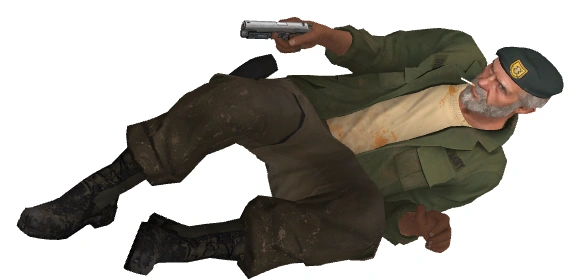
Bill incapacitated.
Once a survivor's health has depleted to 0, that character becomes incapacitated and falls to the ground with 300 temporary health (if some temporary health remained before they got hit, they may get added to the 300 health total). The incapacitated survivor will need another non-incapacitated survivor to help them up, or else they will eventually bleed out and die. The health will slowly tick down by three until death unless someone is in the process of reviving them.
Incapacitated Survivors only have access to their secondary weapon for defense. In the case that the Survivor used a melee weapon at the time of going down, it will be temporarily changed into a P220 Pistol. An incapacitated player's pistol will have degraded accuracy, rate of fire, and reloading speed (excluding the Magnum Pistol where it retains its accuracy and rate of fire). A melee shove can not be performed by an incapacitated survivor.
Friendly fire mechanics whilst incapacitated differ between Left 4 Dead and Left 4 Dead 2. It is left active in the former, and teammates will suffer health loss from an incapacitated player's careless shooting. However, it is disabled in the later game so incapacitated players can shoot freely without regard to their teammates' health.
Incapacitated players take reduced damage from Witch attacks and Spitter goo; whilst a Tank (aside from Versus), a pouncing Hunter and the Common Infected will inflict increased damage. An incapacitated team member being pounced by a Hunter is thus a priority rescue task. However, Tanks can still pose a major threat to incapacitated players if they have access to movable props such as cars or dumpsters to block any attempt to rescue said players. If a Tank knocks such an object into an incapacitated Survivor, the object may damage them multiple times, resulting in instant death. In the case that it doesn't, it may prevent other Survivors from helping them up. Having a Tank near an incapacitated survivor will often cause the Tank to pound them rather than punching others nearby, except in Versus, where the Tank will simply hit everyone instead. This can allow other Survivors to quickly kill the Tank, though failing to do so in time will likely result in the incapacitated Survivor dying.
Smokers, Chargers, and Jockeys cannot use their special attacks on an incapacitated Survivor; Smokers, Chargers, and Hunters won't release an incapacitated Survivor until killed, shoved (except Chargers who cannot be shoved), stumbled (by the explosion), or the Survivor is dead. Meanwhile, the Hunter can also pounce on an incapacitated Survivor while a Spitter can also spew acid on them, making these two specials a huge threat (although Spitter deals less damage on an Incapacitated survivor).
Boomers are a serious problem as the downed player may be covered in Boomer bile and surrounded by Common Infected or explode next to the Survivor trying to revive them, thus making it exceedingly difficult for teammates to make a timely rescue and resuscitation. The Riot Infected perhaps is the biggest threat among the horde due to their bulletproof armor making it hard to land a hit on their backs as shoving is disabled upon incapacitation.
Incapacitation can also occur when a player falls and hangs from a ledge. The reduced damage effects referred to above come into play, but hanging players cannot defend themselves in any way. Health damage from hanging from a ledge is only temporary, and the player recovers to normal status on being pulled back up by a teammate (refer to the following section for advice on how this effect can be used to a player's advantage during gameplay).
Valve had planned to add an ability that allowed incapacitated players to crawl slowly (in fact, there is an unused animation regarding this). Despite being cut, however, it's used in some modded servers.
When an incapacitated Survivor is revived, they'll be left with 30 health points (29 of which are temporary). This is usually a good time to take Pills or an Adrenaline Shot to keep your health up. However, keep in mind that all of your health is only temporary, and will eventually lower back to the point of needing more health. If a Survivor goes down again and is revived for the second time, their vision will turn black and white (more on this below).
Final Incapacitation
- "Don't worry, I can help you. But we need to find you some First Aid, man. If you go down like this again, that's it for you."
- ―Zoey
- "You gonna be okay... Ah, nah, nah, I can't lie to ya. Go down again and that's it for ya."
- ―Coach
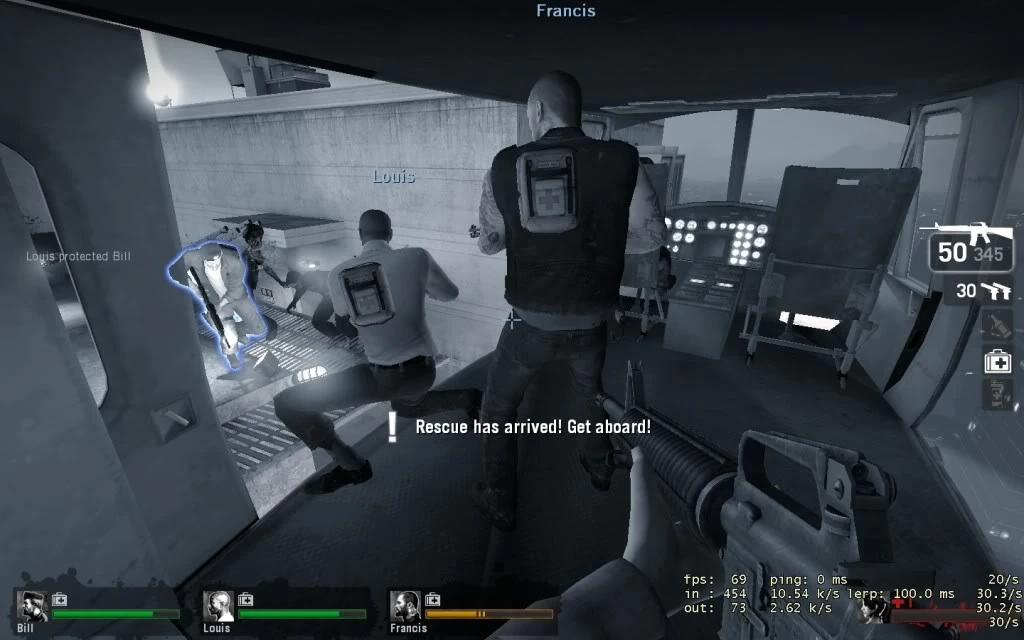
A Survivor's vision after being incapacitated twice and not properly being healed with a Med-Kit.
When a Survivor has been incapacitated twice without being healed, the affected player's vision will turn black and white/grayscale with a notable audio heartbeat; item glows will be red and more intense; and depending on the player's graphical settings, the edges of their screen will become blurred as if they were developing tunnel vision. Reviving Survivors will inform the incapacitated of their impending fate unless they receive healing.
This signals a dire health situation requiring urgent healing. Unless the player is healed with a First Aid kit, they will die once their health depletes a third time. If this were to happen, at that point, the only way to return the dead Survivor to the game is to use a Defibrillator, reach the Safe Room, or free them from a Rescue Closet (Realism is an exception to this, in which Rescue Closets are disabled).
When revived from incapacitation, the survivor's 30 gained health is only temporary (mentioned previously above), and will drain to 1 point of health. If the Survivor's health reaches zero, they will die.
When playing with bots, they will not know when a survivor is black and white. They only attempt to heal survivors with low health, regardless of their current state, which often results in health kits being unnecessarily wasted. The player should reserve their health kit for the direst of situations and try to grab any they may see first.
If there is only one Survivor standing with everybody else incapacitated or killed, it is of the utmost priority to cover that survivor due to that survivor being the only one capable of reviving the rest of the team. If the only standing Survivor is a bot, it will go for the closest survivor and not the one with the least health or in the greatest danger in some situations. Do not try to slow it down by any means, as letting it help another survivor will speed up the process of saving another player, which will still increase the odds of avoiding a team wipe.
Hanging/Clinging
- "I can't hold on, I CAN'T HOLD ON! Help! ! I'M FALLING!"
- ―Louis
- "Hey... I, uh... kind of slipped!"
- ―Rochelle
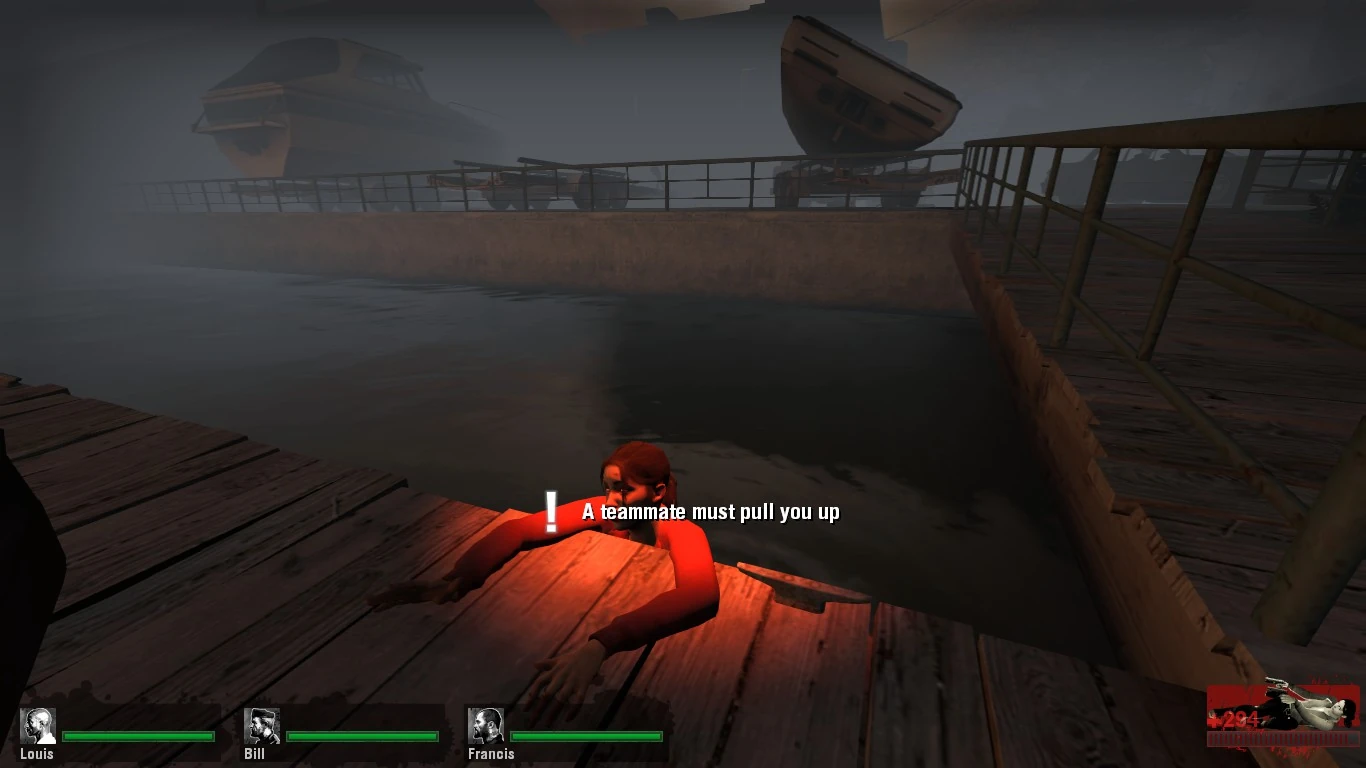
A Survivor hanging.
Hanging or clinging is what happens when a survivor falls off a high ledge. This will cause the survivor to hang off the ledge, and the bleed-out timer will appear at 300 temporary health. As this health falls, the Survivor will begin to precariously hang on the ledge, warning others to quickly pick them back up. If this health reaches 0, the Survivor will lose their grip and fall off, dying upon hitting the ground (or past a set point). In Left 4 Dead 2, this will turn the Survivor's corpse into a ragdoll that cannot be defibrillated, nor does it despawn if the said Survivor is rescued from a closet.
Unlike incapacitation, you are fully helpless and can't use a pistol. While the player can jump to bypass hanging or clinging, this will usually result in immense fall damage or instant death.
A similar rule to standard incapacitation applies when hanging or climbing, except the player's temporary health correlates to the amount of health they'll have when they're rescued; if there is no change, the formerly hanging Survivor will not have any change to their health, while one at full health but was rescued when they had 50 temporary health left will lose most of their health in the process.
Hanging/clinging is usually considered a safe alternative when escaping a startled Witch, as she usually struggles to path towards her target. In places of high elevation, this generally results in her falling to her death.
Death
- "This is going to hell in a hand basket real fast!!!"
- ―Bill
- "Stay close, we're a party of two."
- ―Coach
Upon death, the deceased Survivor will drop all of their weapons, items and turn into a ragdoll. In Left 4 Dead 2, however, the Survivor dies lying on their back with their arms spread apart. Dying does not mean that the player has been eliminated from the game; they can simply wait one minute until transferred to the nearest available rescue closet that has not been previously opened.
In Left 4 Dead 2, alongside closets, Survivors can also be revived by using a Defibrillator. When a death occurs in Left 4 Dead 2, the Survivor will drop all items except their secondary weapon, whether it be Pistols or a melee weapon. This was made so when revived from death, the survivor would have something to use, as the game is not programmed to work correctly when a survivor has no items.
In Finales, Survivors will lose their ability to respawn in rescue closets, requiring a defibrillator to revive the victim.
In Versus and Realism mode, the Defibrillator is the only option for Survivors to return during a level, as they cannot come back to life inside rescue closets; otherwise, they will have to wait until the Survivors are defeated, finished the chapter, or have restarted the round. In one of the Mutations, Death's Door, death will occur as soon as a Survivor's health reaches zero since incapacitations are disabled. Hanging off a ledge is still enabled as it is a different form of incapacitation.
If all Survivors are either dead or incapacitated during the course of the game in Campaign, Realism, or if the player dies in Single Player, then the chapter they were on will restart, with everyone back at the last safe room, with their health, weapons, and items restored to what they had when they first entered that particular safe room during the current game. In Versus, Realism Versus, and Scavenge, control of the Survivors and Infected are switched between the two teams. In Survival, the Survivors simply start a new round with everyone alive and at full health with First Aid Kits and Pain Pills.
There are several other ways to lose the game related to death:
- Being fully overcome by the Infected, leaving the group unable to play. However, if one or more Survivors are incapacitated, and the last standing is grabbed by a Smoker, Hunter, Jockey, or Charger, the incapacitated Survivors can still save the other Survivor by killing off the special infected with their Pistols/Magnums and won't end or restart the chapter if the last Survivor was saved before incapacitation.
- Once a Jockey incapacitates a Survivor, he will jump off, allowing the Survivor to use their sidearm to help teammates (if within range). This often happens when the Jockey leaps on a Survivor with low health, incapacitating the Survivor faster and not be ridden away.
- The game is only over when every Survivor is either dead or incapacitated, meaning there are still things that can kill the Special Infected or force them to release the Survivor nearing incapacitation or death, such as an explosion (an exploding Boomer, an item that is already been shot or on fire, a thrown Pipe bomb, or a grenade that is already in the air), a "friendly" attack from a Tank, or fire that is already burning on the Special Infected.
- Hanging from a ledge counts as incapacitation, meaning if three survivors are hanging from a ledge and the fourth survivor's health reaches zero, the game will end.
- All player survivors are dead in Campaign, Realism, Versus, Realism Versus, and Scavenge, leaving the bots alone.
- However, this will not be the case if
sb_all_bot_team(orsb_all_bot_gamein Left 4 Dead 2) is set to 1. If there are no human players alive, the Survivor bots will run through the map on their own. If they find a human player in a closet or reach a safe room, the game will continue as normal with the human player leading the Survivor Bots again. Note that bots struggle to start crescendo events and effectively run through a rolling crescendo on their own. They can even teleport through a Crescendo item to proceed with the chapter. - This can also be changed for the campaign versions to continue with only bots alive in the second game with an add-on in the Steam/PC version (it works online).
- However, this will not be the case if
Upon a player's death, three different kinds of text will appear.
The survivors have been overwhelmed: This only appears if no Survivors are standing or the player dies while in Single-player. After a few seconds, the current chapter will be restarted.
You will be rescued soon: This appears during online cooperative game modes before the finale (Campaign and Mutations that use coop as the base game mode) as players can be revived via rescue closets or defibrillators.
- In Realism mode, this text doesn't appear, but it is still possible to be brought back to life anytime with a defibrillator.
But your teammates can still escape: Only appears during the finale chapter of a campaign after the rescue has been summoned. This means that the Survivors can still escape as long as at least one player is alive.


Healing
- Main article: Healing items
Health can be restored in various ways:
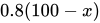
- Using the First-Aid Kit removes all temporary health, and then restores 80% of the player's current missing health as permanent health.
- In other words, if you have permanent health, using a first-aid kit grants you additional health.
- No matter how much your health is, when you heal, your health will always be either at 80 or above.
- This can technically reduce your health total if you have enough temporary health. For example, if you have 50 permanent health and 50 temporary health, your total would be 100. If you then use a first-aid kit, then all of your temporary health is removed, and 40 of the 50 remaining points are healed, leaving you with a total of 90 permanent health, less than the original 100.
- Using Pain pills grants 50 temporary health, which will slowly decrease to normal health as time passes.
- Using an Adrenaline Shot grants 25 temporary health. The Adrenaline also makes you immune to melee fatigue and the horde's slowing melee attacks and allows the player to perform actions faster for a short time.
- All forms of temporary health reduce at one point per 5 seconds (3 seconds in Left 4 Dead 2).
- When you take damage, your permanent health drains before your temporary health.
- The Defibrillator can be used to bring a dead Survivor back to life. The Defibrillator will take the space of the first-aid kit. It is a good idea for a Survivor with the least health to carry it because:
- They won't (or shouldn't) have a health pack to drop.
- If they die, another Survivor can pick it up and use it on them.
- The Defibrillator has a lightning bolt icon when carried. When you are revived with the Defibrillator, you will be given 50 permanent health points, similar to how you'd be given 50 permanent health points after being taken out of a rescue closet.
- Being revived from incapacitation grants the Survivor 1 permanent health and 29 temporary health (giving a total of 30). Incapacitating a teammate in order to do this is not recommended as a form of healing.
- Being rescued from a rescue closet grants the Survivor 50 permanent health and Tier 1 Weapons. The type of weapon depends on what the Survivor was carrying when they were killed. For instance, if the Survivor had an Assault Rifle, that Survivor will get a Submachine Gun when they are rescued. This will not occur if the Survivors are overwhelmed and restart the chapter.
- With the mutation, Bleed Out, players only have temporary health. However, Pain Pills and Adrenaline Shot can bring them back from Black/White Mode, thereby resetting the incapacitation count. But, the heartbeat sound stays. (In most modes, you need a First-aid kit.)
- With the mutation, Healing Gnome, has a gnome that players must escort from level to level, and it recovers a survivor's health while being held by restoring 1 health point per half-second. This is the only way in the entire game that a survivor can recover health that does not involve the use of healing items, and it is also the only way a survivor can regenerate health over time, whereas it cannot be done anywhere else.

Achievements
Left 4 Dead
 |
STAND TALL | (20G) |
| Survive a campaign without being incapacitated. | ||
 |
UNBREAKABLE | (30G) |
| Finish a campaign without being healed by a first aid kit. | ||
 |
FIELD MEDIC | (20G) |
| Heal 25 Survivors with a first aid kit. | ||
 |
DEAD GIVEAWAY | (10G) |
| Heal a fellow Survivor when your own health is below 10. | ||
 |
HELPING HAND | (20G) |
| Revive 50 incapacitated Survivors. | ||
 |
BACK 2 HELP | (20G) |
| Leave a safe room to save an incapacitated teammate and bring them back safely. | ||
 |
PHARM-ASSIST | (20G) |
| Give pain pills to 10 Survivors. | ||
Left 4 Dead 2
 |
THE QUICK AND THE DEAD | (30G) |
| Revive 10 incapacitated Survivors while under the speed-boosting effects of adrenaline. | ||
 |
SHOCK JOCK | (30G) |
| Revive 10 dead Survivors with the defibrillator. | ||
 |
HEARTWARMER | (20G) |
| In a Versus round, leave the safe room to defibrillate a dead teammate. | ||
Gallery


Notes
- Note that you cannot have 100 permanent health again if you have sustained any injury at any point in the game (if you continuously use health kits, the highest that can be reached is 99, and you will not be able to heal again). Temporary health can reach 100 but will slowly diminish over time. This is due to a console variable, specifically,
first_aid_heal_percent, whose default value of 0.8 means that 80 percent of any amount of health lost so far will be restored upon use. Due to the fact that the game cannot account for floating point numbers (numbers with fractional parts) in the context of health, 99 is the maximum attainable once damage has been taken, barring the use of mods or cheats. Setting this value to 1 allows first-aid kits to restore a survivor to complete health. - If all other living survivors are incapacitated or hanging, then the last survivor left standing cannot hang from a ledge, and will simply fall to their demise.
- If you are reviving a survivor that is chest level with you, you will do the healing animation.
- Any Survivors healing themselves as the safe room door closes, and the chapter ends, the healing process instantly finishes regardless of how long the Survivor has been healing.
- In Left 4 Dead, upon a survivor's death, ragdoll physics take effect. In Left 4 Dead 2, the survivors perform a dying animation and assume a set pose when dead. This was done in order to fully support the defibrillator and prevent large bandwidth usage from using a server-simulated ragdoll.
- An odd quirk in Left 4 Dead 2 results in survivors that fall after hanging off a ledge and end up using ragdoll physics when killed. They cannot be revived, even if they fall in an accessible area. This can be avoided if they lose their last amount of health to an outside source, causing them to use the death animation.
- As a result of quirks in the Source engine's handling of player physics, if a survivor dies in an elevator that is soon used, their body will stay at its last height, either "levitating" or "sinking through" depending on which direction the elevator proceeds in. If someone manages to revive the deceased survivor, the revived survivor may appear outside the elevator.
- Bots attempting to heal you will stop if you take out any medical items, including the defibrillator.
- They will usually prioritize players for healing. If both a player and a bot are low on health, the bot will attempt to heal the player. In most cases (with the exception of the safe room where the survivors spawn on the map), they will only heal themselves and/or other bots if no living players are in critical condition.
- When a Survivor is revived by another Survivor or freed from Special Infected attacks, they will gain a two-second window of invulnerability, which renders them impervious to all sources of damage, including friendly fire, Witch's claws and heavy objects that can be punched only by a Tank.
- Unintended leftover drowning code can allow Survivors to top their health back to a normally-impossible 100%, as well as convert temporary health to permanent health. Examples of deep-enough water can be found in the Boathouse Finale on Death Toll. If the player can get their head under the water, they will begin drowning. If you exit the water, the health lost from drowning will regenerate as permanent health.
- Converting temporary to permanent health works by letting the drowning take away your permanent health to affect your temporary health next. Exiting the water will let you regenerate as much health you lost, all as permanent health. This also resets the downed counts the survivor can have before entering black and white mode.
- Topping off your health to 100% requires a health-item like Pain Pills or First-Aid-Kits. Wait for the drowning to take away your health until it reaches around half, before using up your health item. If the healing item grants temporary health, follow the same steps described just above. When you exit the water, the lost health will regen back, and if done correctly, you will have a full bar of health.
- Any leftover temporary health will not get removed, thus making it possible to get temporary health exceeding 100% permanent health without cheats like "give health".
- Special Infected can also lose health from drowning if they stay underwater for too long. Strangely, The Boomer will explode upon death and The Spitter will release acid upon death from drowning. Additionally, Hunter cannot leap underwater.
- In Left 4 Dead 2, it is possible to heal yourself and revive a teammate at the same time by timing the two actions.
- In the mutation "Healing Gnome," holding Gnome Chompski is the only way to heal, with no permanent or temporary health since no Health Packs, Pain Pills, or Adrenaline spawn in the campaign. Getting rescued from a rescue closet starts you with 50 temporary health.
- If a Survivor at exactly 1 health hangs near an edge and gets helped by a teammate, they will be healed back to 30 temporary health. This can be used if there are no other forms of temporary health available to the team.
| Healing Items | |||||||
| Left 4 Dead | Left 4 Dead 2 | ||||||
|
|
|
|
|
|
| ||


